
Operations
Blanket Gold Mine
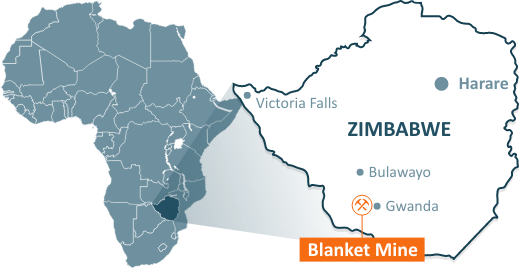
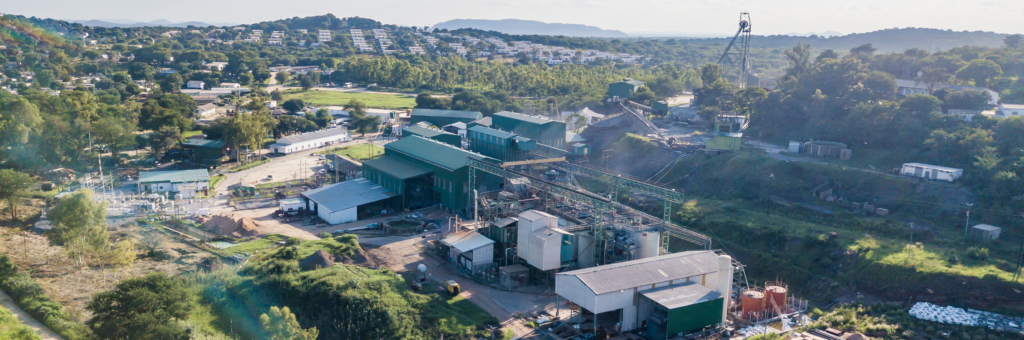
Blanket Mine is Caledonia Mining’s flagship producing asset and the cash-generating foundation of the Group. Located near Gwanda in Matabeleland South, south-west Zimbabwe, Blanket is a long-established underground gold mine with extensive infrastructure, an experienced workforce and significant opportunities to extend production and mine life.
The mine produces approximately 75,000 ounces of gold a year and is supported by a substantial underground mineral resource base. Continued investment in exploration, underground development, operating systems and processing infrastructure is intended to support consistent production while identifying opportunities to increase output and reduce unit costs.
Blanket at a Glance
- Location: Near Gwanda, Matabeleland South, Zimbabwe
- Ownership: 64% Caledonia Mining; 36% Zimbabwean shareholders
- Operation: Underground gold mine
- Annual production: Approximately 75,000 ounces
- Current operating depth: Approximately 1,260 metres below surface
- Underground measured and indicated mineral resources: 17.7 million tonnes at 3.83 grams per tonne containing 2.178 million ounces of gold
- Underground inferred mineral resources: 6.9 million tonnes at 3.35 grams per tonne containing approximately 748,000 ounces of gold
- Surface indicated mineral resources: 1.251 million tonnes at 0.76 grams per tonne containing 30,000 ounces of gold
- Surface inferred mineral resources: 492,000 tonnes at 0.89 grams per tonne containing 14,000 ounces of gold
Technical disclosure note: Mineral resources are reported on a 100% project basis. Mineral resources are inclusive of mineral reserves and are not mineral reserves. Mineral resources that are not mineral reserves do not have demonstrated economic viability
An Established Zimbabwean Gold Mine
Gold mining at Blanket began in approximately 1904. Caledonia acquired the mine from Kinross in 2006 and restarted production in April 2009. Since then, Caledonia has invested extensively in expanding and modernising the operation and developing the infrastructure required to support deeper mining and long-term production.
Blanket produced approximately 76,000 ounces of gold in 2025, compared with approximately 11,000 ounces in 2009. This growth reflects sustained investment in the mine, including the construction of the Central Shaft, the expansion of underground development and processing infrastructure, the commissioning of a solar plant and the resumption of underground exploration.
Today, Blanket is central to Caledonia’s strategy. It provides established production and cash generation while supporting investment in the Group’s wider portfolio of Zimbabwean gold assets.


Central Shaft
The Central Shaft is the centrepiece of Blanket’s underground infrastructure and an important platform for the mine’s long-term future.
Constructed between 2015 and 2021, the six-metre-diameter, four-compartment shaft extends to a depth of approximately 1,200 metres. The project was completed without external financing and was funded from Blanket’s internally generated cash flow.
The broader Central Shaft expansion programme, including shaft sinking, horizontal development, a new tailings storage facility and associated infrastructure, represented an investment of approximately US$150 million. The six-year project was completed without a fatality and with two lost-time injuries.
Central Shaft provides the infrastructure required to support deeper mining, underground exploration and mineral resource conversion. Its increased operating capacity also enabled Caledonia to restart deep underground exploration at Blanket following its commissioning in 2021.
Mining operations at Banket
The current Blanket mining area has nine ore shoots in the producing section of the mine. The majority of the mine’s production is sourced at present from the Blanket, AR Main and AR South ore bodies.
AR Main and AR South represent Blanket’s larger ore bodies, are up to 30m wide and are ideally suited to the long-hole open stope mining method, while the remainder of the Blanket ore bodies are tabular and better suited to the underhand stoping method.
The successful commissioning of the Central Shaft in March 2021 enables Blanket to increase production to over 67,000 ounces in 2021, over 80,000 ounces in 2022 and between 75,000 and 80,000 ounces in 2023. The Central Shaft project has been a six-year project costing approximately $67 million. The capital investment project allows production from three additional levels below 22 Level (750m).
A fourth level will be added via a decline construction giving access to even deeper resources. Blanket utilises both long-hole open stoping (wider ore bodies) and underhand stoping (narrower ore bodies) mining methods. Blanket operates five declines, ranging from 750m to 930m deep. Ore and waste are hauled by 11 load haul dumpers and dump trucks to 22 level for declines servicing blocks from 750m to 870m.
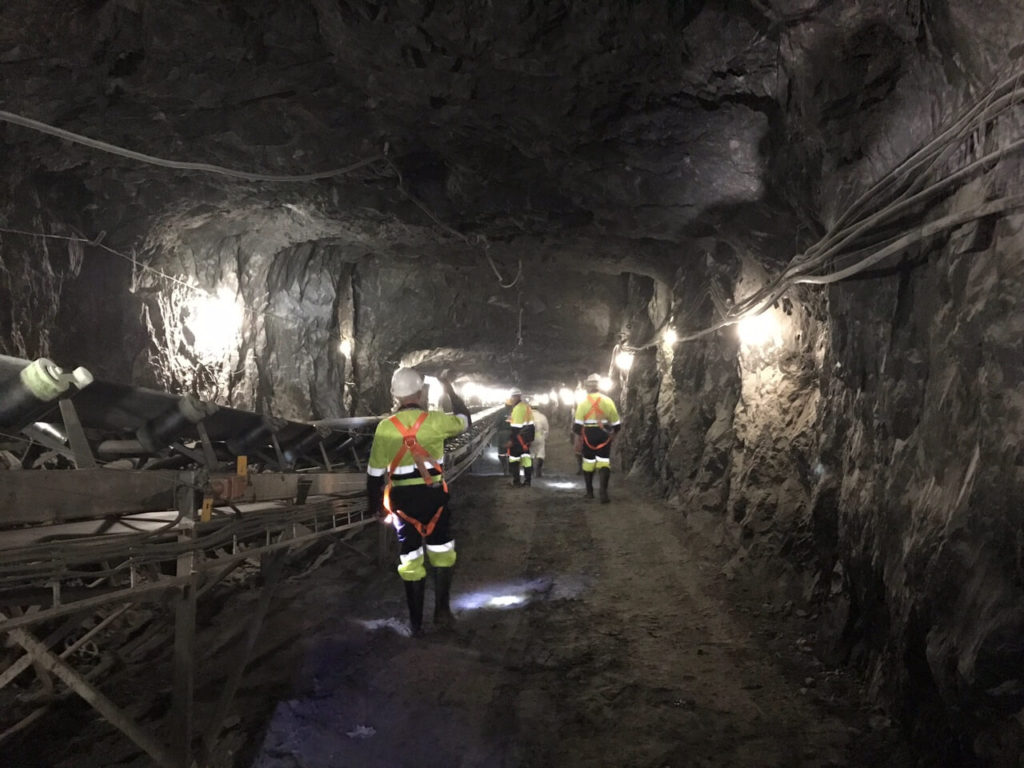
Tramming on 22 Level is done on a rail system by battery locomotives and the ore cars are self-tipped onto grizzlys above the ore bins which are located below 22 Level. Ore is gravity fed from ore bins into a crushing station conveyor which discharges the ore into a vibrating grizzly feeder which discharges the oversize ore into a 30” x 20” Telsmith jaw crusher. Below 870m ore and waste are hauled by load haul dumpers and dump trucks to grizzlys at 26 Level of the Central Shaft and hoisted out from the loading level at 35 Level. Approximately 960 tonnes per day are mined from these declines.
The underground crushing station ensures that all the run-of-mine ore is reduced to less than 150mm in size as this provides for optimisation and greater efficiency of the automated skip loading and hoisting operations. This allows mining and hoisting activity to continue without interruption. The entire underground and surface operations of the Blanket Mine, except for the Lima Shaft, including the surface compressors and the No 4 Shaft Winder, can be operated by the 10,000kVA standby dieselpowered generating sets which were installed and commissioned in May 2011. The Lima Shaft is also used for hoisting smaller amounts of ore to surface.
Over recent years Blanket increased its diesel generating capacity to 18MW of installed capacity which was sufficient to maintain all operations and capital projects but only on a stand-by basis. The total Blanket power supply is obtained from a mix of utility, generator and solar power.
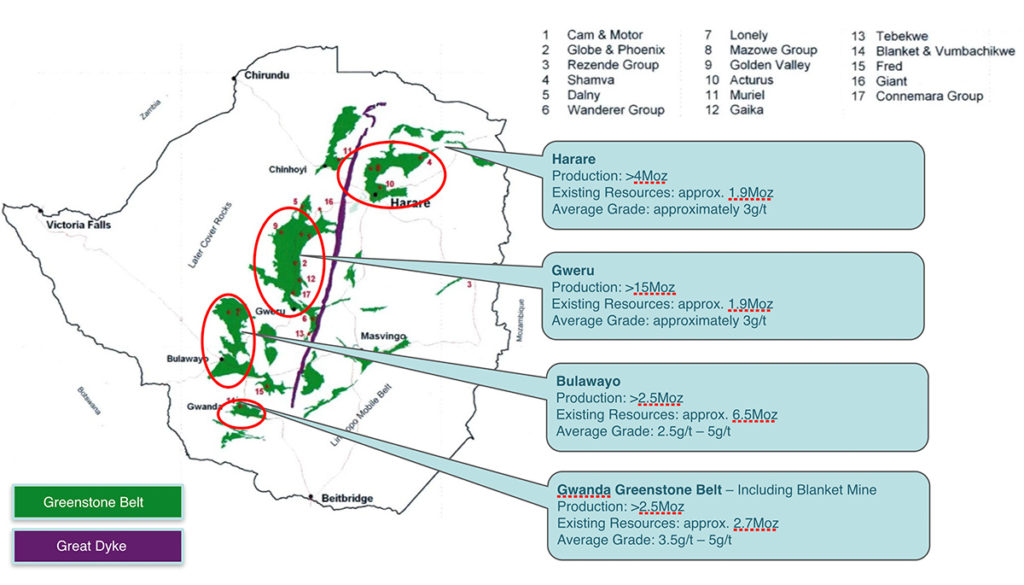
Zimbabwe’s known gold mineralisation occurs in host rocks of the Zimbabwe Craton, which is made up of Archaean rocks. The geology of the Craton is characterised by deformed and metamorphosed rocks which include high-grade metamorphic rocks, gneisses, older granitoids, greenstone belts, intrusive complexes, younger granites and the Great Dyke. The Chingezi gneiss, Mashaba tonalite and Shabani gneiss form part of a variety of tonalities and gneisses of varying ages.
Three major sequences of slightly younger goldbearing greenstone belt supracrustal rocks exist: • Older greenstones called the Sebakwian Group, which are mostly metamorphosed to amphibolite facies. They comprise komatiitic and basaltic volcanic rocks, some banded iron formation (“BIF”), as well as clastic sediments.
- The Lower Bulawayan Group, which comprises basalts, high-Mg basalts, felsic volcanic rocks and mixed chemical and clastic sediments. The Lower Bulawayan Group forms the Belingwe (Mberengwa) greenstones.
- The Upper Bulawayan (upper greenstones) and Shamvaian groups, which comprise a succession of sedimentary and komatiitic to tholeiitic to calc-alkaline rocks.
Three metamorphic belts surround the Zimbabwe Craton:
- Archaean Limpopo Mobile Belt to the south
- Magondi Mobile Belt on the north-western margin of the Craton
- Zambezi Mobile Belt to the north and northeast of the Zimbabwe Craton
Blanket is situated in the Gwanda Greenstone Belt, a typical Archaean greenstone-hosted gold deposit. The deposit is situated on the northwest limb of the Gwanda Greenstone Belt along strike from several other prominent gold deposits. Blanket is the largest producing mine in a belt which at one time had 268 operating mines.
The Gwanda Greenstone Belt extends 80km in an east-west direction and consists predominantly of basaltic rocks (greenstones) with minor felsic and ultramafic units. The belt has been intensely sheared and intruded by granites resulting in complex deformation structures and vertically dipping strata. The shape of the gold ore bodies is controlled by these structures, resulting in their near vertical orientation.
The Blanket Mine is situated in the Gwanda Greenstone Belt, a typical Archaean greenstone-hosted gold deposit. The deposit is situated on the northwest limb of the Gwanda Greenstone Belt along strike from several other prominent gold deposits. Blanket is the largest producing mine in a belt which at one time had 268 operating mines.
Active mining at Blanket takes place over a 3km strike that includes multiple discrete ore shoots. Mineralisation occurs in near vertical shoots aligned along an approximately northsouth axis. The ore shoots vary from the tabular to lensoidal quartz ore bodies to the massive to pipe-like disseminated sulphide replacement (“DSR”) ore bodies.
Blanket is part of the group of mines that make up the North Western Mining Camp otherwise also called the Sabiwa group of mines. What is today referred to as Blanket is a cluster of mines extending from Jethro in the south, through Blanket itself, Feudal, AR South, AR Main, Sheet, Eroica and Lima in the north. These ore shoots occur in the Blanket shear zone, a low angle transgressive shear characterised by the presence of biotite relative to the massive amphibolites forming the country rocks.
Gold mineralisation occurred due to the reaction between rising hot fluids and the iron-rich minerals in the shear zones. The reaction involved the formation of sulphide minerals, predominantly arsenopyrite, as the sulphur in solution reacted with iron in the rocks. Gold, which was also transported by the fluids, became attached to the arsenopyrite to form the gold ore. These reaction zones are hosted within the more ductile tensional high strain areas of shear zones.

Metallurgical Process
The skips automatically tip ore hoisted to surface into the Shaft Bins on the No4 Shaft headgear. Ore is gravity fed from the Shaft Bins onto the No1 belt which conveys the ore over the automated belt scale and to vibrating screens and 14×24 Telsmith jaw crushers. This crushing circuit reduces the ore to minus 50 mm and it is then deposited by the No 2 belt stockpile conveyor onto the coarse ore stockpile which has a live capacity of approximately 2,000 tonnes of material. Ore from the coarse ore stockpile is then fed onto the triple-deck vibrating screen with the oversize being crushed to minus 12 mm by one of two 38H Telsmith Gyrasphere crushers. The 12mm ore is then fed into the 600 tonne Mill Bin which feeds the two (of the three installed) 1.8 x 3.6 m rod mills where it is milled down to approximately 70% passing 75 microns, before being passed through two 30 inch continuous Knelson Concentrators where approximately 49% of total gold production is recovered. The Knelson Concentrator tails are pumped through cyclones and into a 3.66 x 4.9 m x 750kW (1,000 HP) regrind ball mill. As part of the No.4 Shaft Expansion Project, the capacity of the secondary crushers was increased to over 2,000 tpd and the capacity of the rod mills was increased to 1,800 tpd. The slurry from the regrind mill is pumped into a carbon in leach (“CIL”) plant consisting of eight, 600 cubic meter leach tanks equipped with 45 kW agitators where leaching at 50% solids and simultaneous adsorption of dissolved gold onto activated carbon takes place. The CIL plant has a nameplate capacity of 3,800 tonnes of milled ore per day. Elution of the gold from the loaded carbon and electro winning is done on site. Gold is deposited onto steel wool cathodes, the loaded cathodes are acid-digested and the resultant gold solids are smelted in an induction furnace to produce gold bullion of approximately 90% purity, after which the bullion is sold as required by Zimbabwean law to Fidelity Printers and Refiners (Fidelity) in Harare which undertakes final refining and sale. The proceeds of sale (i.e. 98.5% of the value of the gold contained before payment of any royalty) are paid directly into Blanket’s foreign currency account with its commercial bank in Zimbabwe within 7 days of receipt of the gold by Fidelity.
Overall gold recovery rates have been increased from 85% at the time of acquisition by Caledonia to over 94% as a result of the re-design of more efficient CIL agitators and the installation of an automated liquid sodium cyanide facility which allows for multiple stage cyanide dosing and monitoring of the CIL. The PSA (Pressure Swing Adsorption) Oxygen Generator has been re-commissioned and the controlled sparging of oxygen into the CIL has resulted in an increase in leach recoveries to approximately 94%.
No. 1 Conveyor feeding the two Primary Jaw Crushers. Tailings from the CIL circuit contain less than 30 ppm of cyanide, and are pumped to one of two tailings dams which are operated and maintained by Fraser Alexander, and are inspected and monitored daily by Blanket.

Consumables used in the metallurgical plant (e.g. grinding media, reagents etc) and the mining operations (explosives, detonators, drill steels etc.) are currently sourced primarily from South Africa.
Historical operating statistics for the Blanket Mine are available in Caledonia’s MD&A, which can be found in the Investor section of Caledonia’s website. Blanket’s historic financial performance up to February 2009 was accounted for in Zimbabwean dollars until 2009. Due to the extreme hyper-inflationary environment which prevailed in Zimbabwe until early 2009 and the resultant devaluation of the Zimbabwean dollar, Blanket’s stated historic financial statements are unhelpful for the purposes of evaluating Blanket’s historic financial performance. The Zimbabwean dollar was abolished in February 2009 and all financial transactions in Zimbabwe now take place using other currencies, including the US Dollar, the South African Rand and the Botswana Pula. With effect from 1 January 2009, Blanket has prepared its accounts in US Dollars.
Central Shaft
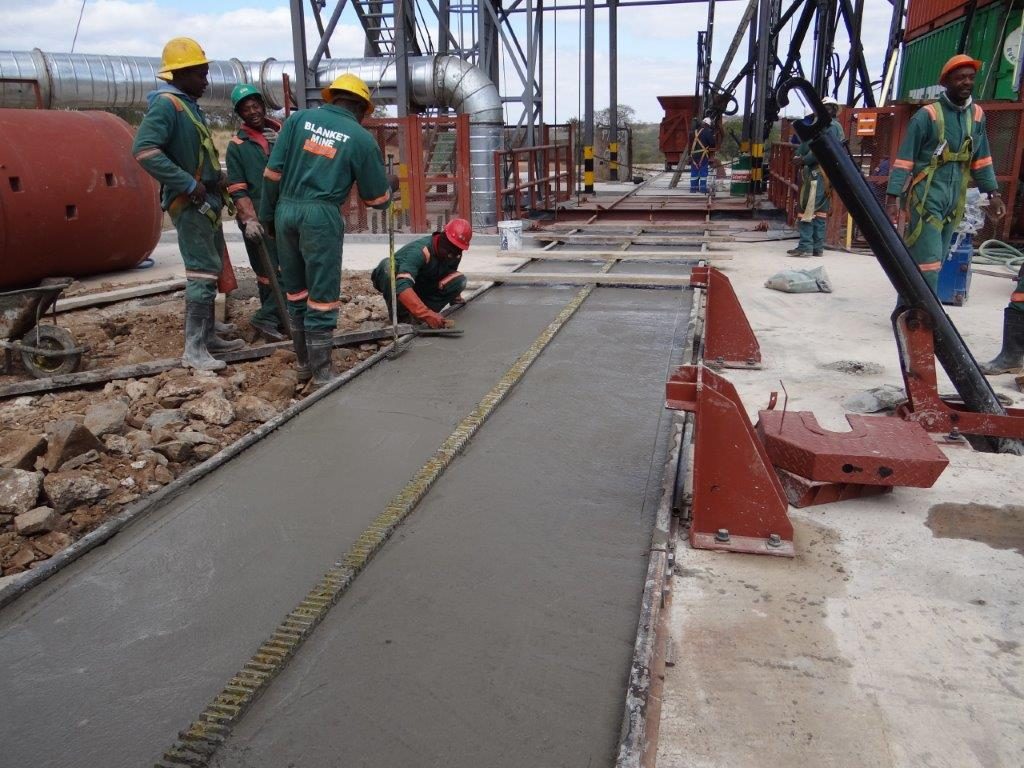
Commissioned in Q1 2021, the Central Shaft is a 3,000 tonne per day, 6-meter diameter, 4-compartment shaft that will transport men, equipment and material from surface to 1,800 meters below surface. It is located between the AR Main and AR South ore bodies, in the middle of Blanket’s mining area. Construction on the shaft commenced in August 2015, following completion of the Tramming Loop. The capital cost of the Central Shaft was approximately US$67 million, all funded through internal cash flow. The shaft was sunk in two simultaneous phases: from surface and the other from 750m below surface. Now completed, the Central Shaft will provide access for horizontal development in two directions on two levels below 750m, increasing production to 80,000 ounces from 2022 onwards and extending the life of mine.
The increased investment pursuant to the Revised Plan is expected to give rise to production from inferred resources of approximately 70-75,000 ounces in 2021, this being in addition to projected production in 2021 from proven and probable mineral reserves of approximately 6,000 ounces. The Revised Plan is also expected to improve Blanket’s long term operational efficiency, flexibility and sustainability.
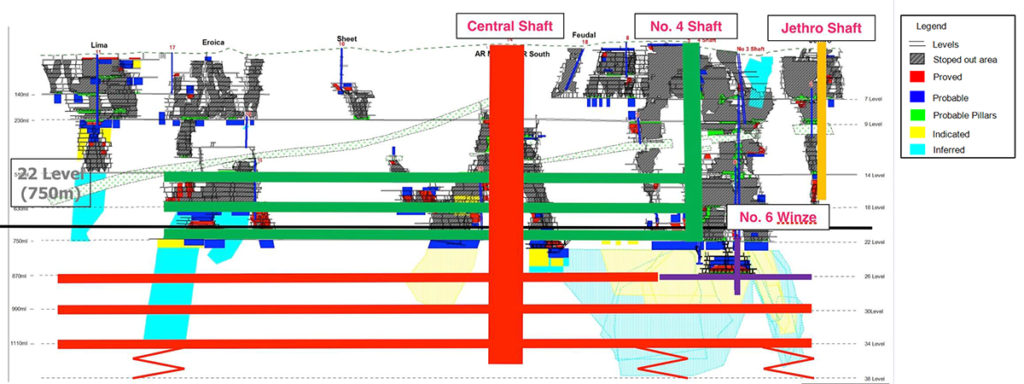
The Revised Plan includes a revised life of mine plan for the Blanket Mine (the “LOM Plan”) in terms of which it is anticipated that the approximate production from existing proven and probable mineral reserves above 750 m level will be as set out below.
Approximate production from proven and probable mineral reserves above 750m (per LOM Plan)
Central Shaft and the associated capacity improvements in the Blanket Processing Plant are expected to enable an increase in gold production at Blanket to 75,000 ounces by 2021 and 80,000 ounces from 2022 onwards. Improved access to Inferred Mineral Resources at depth is expected to enable the maintenance of this 80,000 ounce per year production rate until approximately 2034.
The new Central Shaft and the deepening of No 6 winze will provide access to the current inferred mineral resources below 750 meters and allow for further exploration, development and mining in these sections along the known Blanket strike, which is approximately 3 kilometers in length. The PEA has been prepared in respect of the inferred mineral resources below 750 meters. Based on the PEA, additional approximate production from current inferred mineral resources (excluding the projected production set out above) may be achieved in the following indicative ranges:
Possible production from inferred mineral resources below 750m (per PEA)
Canadian rules do not allow production from inferred resources to be added to those from proven and probable reserves for reporting purposes.
The PEA is preliminary in nature and includes inferred mineral resources that are considered too speculative geologically to have economic considerations applied to them that would enable them to be categorized as mineral reserves. There is no certainty that the PEA will be realised. Diamond drilling and development will continue with the objective of increasing confidence in order to upgrade the categorization of the resources.
The LOM Plan and the PEA have been reviewed by Minxcon Consulting, an independent mining consulting company. A technical report prepared in compliance with National Instrument 43-101 which summarizes the revised LOM Plan and the PEA will be filed on SEDAR before December 17, 2014. The most important assumptions on which the PEA is based include, a gold price of US$1,200 per ounce, achievement of the targeted production set out above and the accuracy of the projected capital costs.
It is also intended to continue exploration at two of Blanket’s satellite projects, Mascot and GG. No production forecasts are attributed to mining activity at either GG or Mascot at this stage as neither of these currently have defined NI43-101 mineral reserves or resources.